This academic blog will illustrate and explain the distinction between the idioms of nation, State and nation-State. The essay will draw on the Australian Federal political structure (past and present), the 1901 Federation policy and the Multilateral Agreement on Investment (1998) to act as a framework in demonstrating the divergence of functionality within these terms. The essay will also approach the definition of the State by combining, functional and integrationist perspectives to classical capitalist and class theories i.e. Marxism, neo-Marxism, liberalism and neo-liberalism.
The analysis will investigate this social phenomenon using a discourse analysis of various political authors such as Aitken et al. 2006; Davies et al. 1993; Fukuyama 2004; Hungerford 2006; Pusey 1993 (cited in Najman and Western 2000); Kukathas et al. 1998; Marshall 1998; White 1981 and various others.
It also focuses on the ‘Commonwealth of Australia Constitution Act, Chapter I: The Parliament, Part V – Powers of Parliament’ to highlight multiplicity of State authority. Due to the extensive range of State responsibilities, this essay will concentrate on the parameters of economic policy and the nation’s welfare to illustrate the definitions and concepts discussed.
Definitions:
Firstly, it is critical to define the terms nation, nation-State and power within the contexts of this essay.
Nation: Nations create borders – thus separating people, cultivating pride as well as propagating cultures. Through the recognition of national boundaries, citizens define themselves in terms of their relationships within those boundaries, '... on one side are the kindred spirits and on the other are the “outsiders” ‘(Clampitt 2005, p. 181). Nation State (State):
A socially constructed institution, which claims overall authority over members of the nation (Marshall 1998). Currently, there are 129 nation States registered under the United Nations banner (Aitken et al. 2006). The State, by Pusey’s (1993) definitions, effectively governs the nation’s ethnic social unit. The police, government, military, bureaucracy, The Australian Constitution, and legislature are one unit in terms of describing the State.
Australia, as a sovereign State, possesses four fundamental components:
· The right to govern its own affairs · The right to enact or not enact it own laws (i.e. Emissions Trading Scheme) · The right to reserve a rational sense of values, nationhood and cultural identity · The right to determine its own economic policy, choosing to trade with other nations as it chooses (Hungerford 2006; Pusey 1993).
Its functional role, again by Pusey’s (1993) definitions, is to limit internal power by controlling struggles and conflicts, thus creating internal order, as well as exercise power towards other countries to protect the State’s interests. In addition, the State controls societal members through the pursuit of united goals and a degree of social solidarity; acknowledges the interests of diverse groups; aligns those interests in the policy making process and performs a welfare role (Hungerford 2006). The welfare role was essential following the birth of capitalism and the failure of free market forces (Aitken et al. 2006; Fukuyama 2004; Hungerford 2006; Pusey 1993; Kukathas et al. 1998).
Power :
Power is defined by Lukes’ (1993) three-dimensional view of power. Lukes recognises the influence of human agency, ‘... to assume that it is in exerciser’s or exercisee’s power to act differently’ (Lukes 1993 p. 26). This viewpoint correlates in direct contrast to Dahl (one dimensional) and Bachrach and Barratz (two dimensional) theories.
Since Australia’s colonial beginnings, the State has intervened considerably in the development of a nation that has been open to international ethnic and social forces. Max Weber argued that the nation State is fundamentally a political organisation that claims binding authority through the monopoly of force and all other institutions are subordinate to its authority and power (Aitken et al. 2006; Marshall 1998).
This was the case at the time of Australian Federation (1901), wherein a fledgling nation depended heavily on Colonial Statism for its survival. Primary producers, for national economic survival, embraced the intervention of Statism. In terms of classic Marxist theory, the State promoted the elites who in turn promoted the State (Davies et al. 1993).
Moreover, Colonial Australia relied heavily on its ‘white’ immigrant population to provide cheap labour for the English capitalist marketplace. However, Australia in terms of immigrations was considered a ‘Hell on Earth’. Additionally, some critics described Australian society at this time as ‘deprived, drunken and unruly’, whereby convicts, selectors and their children where held in little regard.
These types of beliefs served as a damaging negative contrast to the identity the Barton Liberal Protectionist government of the day wanted to promote to the ‘immigrating’ world. Therefore, in a nation building attempt to counteract these conceptions, the founding ‘myths’ of the ‘workingman’s paradise’, the Aussie ‘battler’, the ‘Lucky Country’, and the idea of a ‘fair go’ were woven into the imaginary framework of the nations cultural identity. Consequently, representations of Australia’s nationalism have fundamentally been a ‘mythic’ creation which best served the interests of the English capitalist marketplace (Turner 1993; White 1981).
Additionally, in 1901 there were no formations of political parties by contemporary standards. However, there were small groups of like-minded people who held certain political values and beliefs. Colonial settlements were basically separate colonies that recognised the desire for nationhood, and a need to amalgamate and coordinate critical governmental functions. Much of the ideology of Federation clearly reflected the economic concerns of the capitalist elites that also included proposals of minimal State intervention (Davies et al. 1993). However, the creation of the Federal three-tiered ‘Westminster’ political system and the drafting of the Australian Constitution restricted the open slather power grab of a dominant unitary government and the second tier of federal Statism (i.e. in States like Queensland) retained independent self-governing rights.
As well, the governing Liberal Protectionist Party watered down ideas of imperial ‘colonial statism’ and commodity producer’s protection. Due to the increasing pressure by the Australian Labor Party, Barton’s members became more active with the Free Traders Party; increasing its welfare function to its citizens as well as playing a major role in adjudication and conflict resolution between the bourgeoisie and the proletariats.
As an early historical example of this functional interventionism, the Australian economy was especially vulnerable during the periods of both World Wars and the Great Depression, as were many other national economies.
Consequently, in 1944, global elitists (business and finance leaders) met at Breton Woods (U.S.) to discuss trade and labour mobility. The mostly U.S. and European delegation believed Hitler’s Nazi ‘socialism’ was a type of nationalism which had caused massive social disorder, and to prevent this situation in the future, national borders should be abolished and nations be united ‘... into a new (global) world order’ (Strachan 1998 p. 135).
This type of ideology began the gradual creation of a supra-national economic organisation, the European Union (E.U.). Australia also followed the ideas and concepts of ‘globalisation’ over subsequent decades by abolishing its ‘White Australia’ policy and enhancing free trade with the outside world by lifting tariffs (Davies et al. 1993). Ironically, the cultural ‘myths’ of the Aussie ‘battler’, the ‘Lucky Country’, and the idea of a ‘fair go’ again became the dominant ideological trope. The nation State played an instrumental cultural and economic role in protecting its nation’s citizens (Najman and Western 2000).
For example, after decades of crumbling national and global economics, the U.S. (Carterism/Reaganism) and Great Britain (Thatcherism) subsequently implemented drastic global marketplace policy changes to decrease growing national and international deficits.
The Hawke/Keating A.L.P. responded by sending the Australian economy and its citizens into the ‘... recession Australia had to have’ (Strachan 1998 p. 7). Such economic catastrophe had many nationalists questioning the welfare role of the nation-State and, in 1996; Australians precipitated the return of Liberal (yet ultraconservative) viewpoints with the election of the Howard government. In the face of weakened operations of the State itself, the Liberal/National coalition made a determined swing towards neo-liberal principles (Pusey 1993).
In order to stimulate national economic growth, the State created and promoted the formation of strong links between international elitists and national labour interests; henceforth, also creating strategic and mutually obligatory policies such as ‘Corporate Perspective’ Agreements. Agreements such as these provided new avenues for addressing the principles associated with Bretton Woods concepts associated with ‘privatisation’, deregulation’ and ‘globalisation’. In addition, these processes yet again enhanced Australia with ‘mythic’ idea’s of being a multicultural land of (capitalistic) opportunity.
Nevertheless, neo-Marxist political commentators such as Bell (1997) and Strachan (1998) argue that the State is now increasingly reliant on the global spread of industrial dealings and the interdependence of the world economic system by being interlinked with various other international economies in terms of production, trade, investment and consumption. The Global Financial Crisis is an ideal example in recent times. The globalising of corporate activity, as witnessed in Trans-National Corporations (T.N.C) and the T.N.C’s subsequent involvement within financial sectors has been causal in the weakening Statism (Bell 1997).
To reinforce this argument, Bell (1997) adds;
‘Australia has the worst current account situation in the O.E.C.D., reflecting strong commodity dependence and ongoing structural weakness in the economy ... economic weakness and State weakness have only reinforced each other’ (Bell 1997 p. 20 of 24).
Henceforth, it is fair to agree that the post-modern State, through economic circumstance, has been causal in its weakening of power, not only from within its national boundaries, but internationally as well. Additionally, such weakening has also made it difficult for Australian citizens to clearly distinguish the functional role of the State, particularly when government partakes in ‘top secret’ economic and political dealings.
In 1998, Pauline Hanson’s One Nation Party exposed Australia’s ‘Multilateral Agreement on Investment’ (M.A.I.) and its resultant legislative policy. Multilateral Agreement on Investment
This Agreement was, in part, a trade off because of the nations ‘... worst
current account situation in the O.E.C.D.’ (Bell 1997 p. 20 of 24).
The Howard coalition government’s ‘less than transparent’ negotiations with the O.E.C.D. effectively made it ILLEGAL for the Government NOT to allow foreign trade (also coined O.E.C.D. elitists) onto Australian soil.
Thus destroying one of The Australian Constitution's fundamental standpoints: The right to determine its own economic policy, choosing to trade with other nations as it chooses.
Conversely, the government justified these dealings to Australian’s by claiming it was creating a trade and industry ‘level playing field’. While other, such as the then Deputy Chairman of the Australian Competition and Consumer Commission (A.C.C.C.), Alan Asher, argued that this concept was unfeasible because ‘... 80% of the economic activity is already managed by international corporations’ (Asher, cited in Strachan 1998 p. 4). Despite their disillusionment, however, the nations citizen’s were extremely clear on one point, that this was not a Constitutional decision made ‘for the people by the people’ and any further M.I.A. discussions ceased.
These dealings gave weight to the increasingly popular neo-Marxist viewpoint that the current form of liberal instrumentality was incompatible with the ideologies of ‘world governance’ and its subsequent organisations i.e. United Nations (U.N.). In addition, neo-Marxists believe only nation States are able to collectively organise legitimate authority (under the umbrella of a U.N. type organisation). This activity, theorists believe, is critical in enforcing the domestic rule of law; hence, States are key players in preserving and protecting global social order.
Equally however, other political thinkers such as Fukuyama (2004) argue that ‘world governance’ leads to further capitalist domination by ‘... a motley collection of multinational corporations, non-governmental organisations, international organisations and crime syndicates’ (Fukuyama 2004 p. 162). These corporations and organisations capitalistically possess increased power over weaker Third World political and economic systems. In addition, Fukuyama (2004) stresses that modern nation building primarily involves ‘the creation of new government institutions and the strengthening of existing ones’ (Fukuyama 2004 p. 152). With this in mind, there is no denying that with the ongoing march of globalism and its spiraling definitions of economic rationalism, Australia has to renegotiate its trade and labour boundaries and its descriptive discourse as a sovereign State.
Fundamentally, it would no doubt serve in Australia’s best interests to do as the E.U. did some 60 years ago in joining economically and monetarily with other nation States in the region. It is conceivable that Australia, New Zealand, Singapore, Indonesia and other Pacific Rim nation States transform into a supra-national governmentality. This type of ‘nation building’ would serve as a win-win situation as, on one hand, there would be multinational-State ‘protectionist’ welfare for struggling countries to be able to more effectively deal with global elitists. While on the other, Australian trade, labour and investment can pro-actively focus on industrial areas of need such as the reformation of manufacturing industries (i.e. wool).
Considering the Australian nation and its formation of the Federation State in 1901, which bought about a multi-tiered system in which States (e.g. Queensland) retained unique governing rights; so too the ideologies of this democratic system can be extended to form a supra multi-national free trade ‘umbrella, while individual nations still retain their exclusive definition of nation State.
In conclusion, this essay has illustrated the distinction between the idiom of nation and State by drawing on the ideologies of the Australian federal political system to act as a framework to demonstrate the divergence of functionality within these terms. Furthermore, the investigation explored Australia as both an ethnic and cultural country and the functionalism of the State by highlighting the policies and ideologies associated with Federation (1901) and the contemporary political system of the post-modern era. Furthermore, the economics of the nation and welfare role of the State were analysed by combining critical, functional and integrationist perspectives to this social phenomenon by means of discourse analysis of various political authors and theorists. Also, recommendations for future ‘nation building’ concepts will effective place Australia and other Pacific Rim nation States as a viable and productive supra-national organisation.
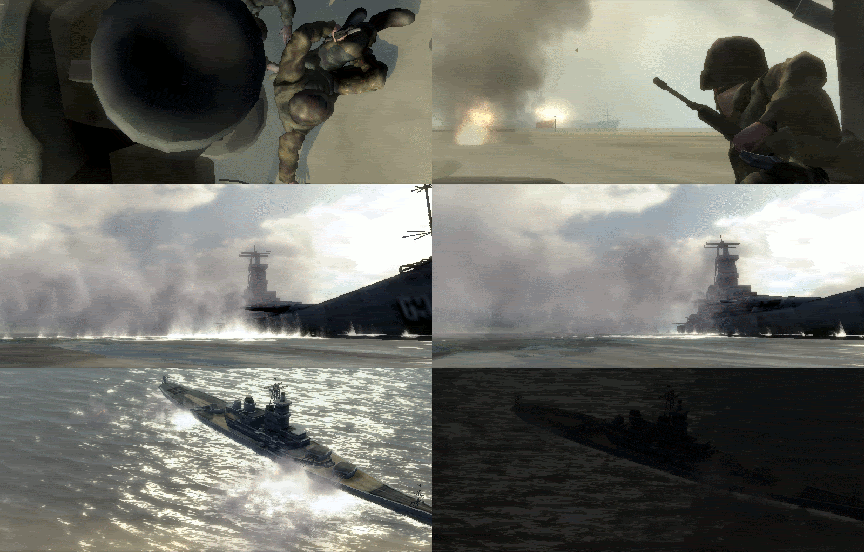
The ground thunders with amphibious assault vehicles capable of emitting massive smoke screens to confuse their enemies. Heavily camouflaged and in close proximity are German Leopard 2A4 Main Battle Tanks with 1500 horse power engines carrying in excess of 55 tonnes and armed with a 120mm caliber smooth form guns. Other weapons of extreme fire power include immense cannons, one aptly titled 'The Punisher', as well as 105mm Hamel Guns, 105mm howitzers and 155mm M198 howitzers. On the sea, the waters are bombarded with live ammunition's from Air Force F-16 Strike Fighter jets, , nuclear powered submarines and naval battle ships, as well as undetonated 'traps' set for the underwater tactical maneuver's.
Other sounds echo through the mountainous ridges and valleys. These are the reverberations of a community at war, a counter-attack of protests motivated by deep concerns over the environmental damage to the region. While troops engage in mock up scenarios of 'real' battle, behind the gunfire and smoke screens is platoons of activist groups and concerned civilians preparing to bear banners, loudspeakers, and 'Letters to the Editor' in protest to the environmental genocide occurring. Locals believe that protesters will outnumber troops this year as yet again the battle lines are drawn in the sand along the Capricorn Coast to ensure that environmental and defence priorities within the area are given equal weight.
One would be forgiven if they believed that these sounds were heard from the battle fronts of some far flung war torn country. However, these are the sounds that are yet again about to be heard from the reef to the outback – quite literally from our own backyard. OUR OWN BACKYARD
All this firepower is contained with a 300km coastline that is Shoalwater Bay, the largest aquatic and coastal wilderness habitat area in Queensland.
Described in local circles as 'Queensland's Kakadu', the marine and estuarine environments provides homes for crocodiles, dolphins, endangered sea turtles including green, loggerhead, hawksbill and flatback, as well as dugongs, whales, and an astounding 445 fish species. Additionally, almost half of Australia's known mangrove species and over 1000 plant species, including five highly threatened species, are found here. This is a sanctuary to large numbers of bats and gliders and home to almost 50% of Australia's bird species.
Renowned author, Ross Gibson, vividly describes the Capricorn hinterlands as behaving like 'A live thing, naturally present and always evolving – a creature animated by its own powers'.
While in Alan Carter's controversial film, Dirty War, a local resident highlights the proximity of the Bay to the World Heritage listed areas of the Great Barrier Reef Marine Park (GBRMA), describing it as 'A huge jewel on the coast of Australia'. While the locals appreciate this area for its genuine uniqueness, it has also been recognised both nationally and abroad.
A 1994 Commonwealth Commission of Inquiry geographically described it as
'The largest coastal area with high wilderness values between Cooktown and southern New South Wales.'
Australia is also involved in the 1971 RAMSAR Convention on Wetlands, an intergovernmental treaty which provides the framework for national and international action for wetlands use. The mangrove, tidal mudflats and salt flats are internationally important habitats for resident and migratory waterbirds, regularly playing host to over 20 000 species.
In short, Shoalwater Bay – our own backyard - is a place of significant environmental value.
The question posed then is why is this area about to again be flooded with a formidable force of some 30 000 military personnel in later this year. A BACKYARD OF HISTORICAL TREASURES
The first recorded European sighting of Shoalwater Bay was on May 28, 1770 by British navigator Captain James Cook. Cook, ironically, never set foot on the mainland, however referred to his navigations from Cape Palmerston to Cape Townshend, as the 'Bay of Inlets'. Cook granted the name 'Shoalwater Bay', after referencing the number of sandbars on the southeastern side. The Bay then remained largely undisturbed until Matthew Flinders conducted further exploration at Akens Island headlands in 1802.
However, there were much greener pastures in the south and the area did not draw much interest from European settlement for another 50 years. By 1860 vast tracts of the Shoalwater Bay region was settled, an activity resulting in the violent dispersal of the traditional landowners, the Darumbal people. If the Darumbal (Tarumbal) possessed written history, they would have no doubt recorded that they dwelt in a land truly abounding in natures gifts of beauty rich and rare. Freshwater sources provided a prosperous abundance of lily roots, water fowl and fish. On the land roamed a varied diet of kangaroo, possum, koala and wallaby. There were also seasonal supplies of nuts, seeds, fruits and vegetables.
William and Field Flowers, whose interest in the region's ecology was appropriate to their names, each gained 486.6 hectares in 1870 which included a block at Raspberry Creek. Paradoxically, this is the within the same location that the ADF now house their Environmental Centre. Australian and US personnel recognise the environmental concerns involved in operating in this area and undergo environmental impact briefings before arriving at the environmental training centre at Raspberry Creek Junction. While history notes that the Flower's brothers respected the social and cultural rights of the local tribes, the people tell a rare myth which may give a much more allegorical insight into what happened to the Aborigines with the coming of white man. The whistler-duck and porcupine once shared land and water territories equally. However, one day a whistler-duck needed a quill for his nose-pin and took one from the porcupines' back without firstly asking permission. The porcupine got upset about this and fought with the duck. However, the duck called on all the other duck species, as well as his own, to help him and eventually they drove the porcupine from the water. He took refuge in the hills, building holes in which to hide, while the ducks monopolised the waterways.
This tale may be just as potent today as it was then, with local dwellers fighting to keep their pristine and peaceful environments against the might of the ADF and US military juggernaut.
HOW WILL DU EFFECT YOU?
The US military's use of weapons containing depleted uranium (DU) continues to be a hot topic, particularly since Australia was encouraged to use it and the after effects can be felt for decades.
According to a 2003 Hansard, 'From 1981 to 1990 the RAN (Royal Australian Navy) expended 43 000 DU rounds at sea during training ... sourced from the US Navy', then further claims 'There was no ammunition left in the inventory after 1990'. It is considered that the Raymond and Townsend Island bombing ranges were repeatedly targeted throughout this nine year period. However, DU related activities continued in the Bay up until four years ago with the involvement of US nuclear-powered naval vessels carrying DU munitions. Shortly after stage one of TS05 was held, the sleepy little coastal community of Yeppoon began to seek answers from the Federal Government on the DU issue leading to the ADF issuing a press release which unequivocally stated, 'Depleted uranium will not be used in Exercise Talisman Sabre 2005 by either Australian or US forces.'
The ADF further claimed, 'The Navy ceased using the ammunition due to occupational health and safety considerations.'
Capricorn Coast Mirror reported that Peter Murray of the Shoalwater Wilderness Awareness Group (SWAG) described the process as a "whitewash".
Nuclear weapons scientist turned whistle-blower, Leuren Moret explains that,
'DU particles are so fine that they behave like a gas. Anyone downwind or within a thousand miles of where this is being used will be exposed.'
While an explosive study by epidemiologists, Hindin, Brugge and Panikkar reveals various health risks associated with DU. The scientists claim,
'Evidence is consistent with increased risk of birth defects in offspring of persons exposed to DU'.
The trio continues by citing a United Nations study that clearly states,
'The most important concern is the potential for future groundwater contamination by corroding penetrators.'
Since crystal clear creeks and perched lakes within the SBMTA area contribute to Yeppoon's main water supply, concerns of local people are reasonable. Fears of the water being contaminated by cancer causing pollutants may be one reason for the then LSC's decision to construct a 50 kilometre water pipeline from the Fitzroy River. DU is not nuclear energy, it is nuclear waste. Whether weapons possessing depleted uranium have been used in Shoalwater Bay may never be known. However, if so the smoking gun will continue to smoulder for 4.5 billion years.
Most concerning is that the ADF acknowledges the US forces are equipped with DU munitions on their war ships. The PER does not rule out DU weapons being on board aircraft landing in Australia or on armoured vehicles. DU was used as ballast in military planes that have crashed in previous Australian exercises. Additionally, accidental firing of DU weapons has occurred in other foreign training areas such as Okinawa, Japan with serious health problems resulting.
Quite literally, the region's residents must sacrifice themselves and their natural environment for the greater good of the nation. DU has proven to be more dangerous than your average ammunition, just the type of material we do not find acceptable in our own backyard.
In terms of social responsibility, the ADF must acknowledge whether the US forces will be carrying DU during TS09.
Defence Consultant, Professor Ross Babbage acknowledges, 'There should be no concern on the part of the public at all.'
He then adds, with a gusto of pro – US sentiment, 'The fact that the United States can access Australia in a crunch, in a crisis, if there were a major crisis in the Indian Ocean for instance then it can swing its forces through this area; that's a useful, very useful thing'. ALL CREATURES GREAT AND SMALL
While the health concerns of residents are largely ignored, it seems that environmental issues refuse to be - particularly when that issue is the size of a humpback whale. June and July is the migratory period through the area for the whales. US submarines use low level sonar for navigation during exercises and can be heard for hundreds of kilometres underwater. Research has found this type of practice to be disorientating and painful for the giants of the deep and has been banned in US waters; however, this is not the case for Australia. In June 2007, the movements of a unique white whale prompted the ADF to consider moving the training site. World renowned oceanic gem, Migaloo, swam too closely to the Bay while ADF admitted concerns that the sonar used could cause him or other whales to beach.
Commander Peter Lockwood claimed special precautions are taken to protect marine mammals, 'At the moment we've got all the environmental risk mitigation strategies in place and we're quite comfortable we can conduct this activity quite safely here without harming Migaloo,' he said.
The ADF considered moving future military exercises away from Queensland's environmentally sensitive Shoalwater Bay area in this time. Commander Lockwood further claimed, 'There are potential other areas around Australia that we're looking at to conduct activities like this' further adding, 'At the moment there's a section in the Northern Territory which we're looking at as a possible future site for activities like this' Lockwood said. A MINEFIELD OF DISCUSSION
Growing awareness and a groundswell of resistance continues to increase in the Capricorn area and has in recent years strongly reflected in the local media. A past Capricorn Coast Mirror article entitled "Military Under Fire" begins by aphorizing,
'Low flying helicopters with armed men visible inside, military devices washed up on shore, it all sounds like scenes from some movie. However, this is no movie – it is happening in our own backyard'.
Frosty 'Letters to the Editor' highlights local opposition as a writer reports
'A stray military phosphorous bomb washed up on a Cap Coast beach, live firing causes extensive wild fires in the bush, and a large area of mangroves totally dead, apparently burnt'. Few Capricorn Coast residents placed much credence in the Government's cover story about it being caused by bad weather.
Local fishermen claim that Army engineers use heavy explosives blasting a massive hole in the dunes on Freshwater Beach, lowering the water table by three metres and draining the swamp into the sea. They also protest about the damaging effects of sonar on local marine life – particularly the deaths of dugongs due to bombings, general military contamination - which has lead to the decimation of mangroves, and the blasting of the Great Barrier Reef.
According to David Bradbury, a well known and long standing Capricorn Coast activist, the Defence Force's regularly set depth chargers carrying between 100 – 500kg of explosives causing an impact that can be seen hundreds of metres in the air from as far as 20 kilometres away.
Byfield resident, Stephen Butler describes the situation as,
'A hyperreal military Disneyland. A miniature theatre of war simultaneously crystallizing and dissimulating the militarisation of the world and Australian culture. The fact that war games are played out - from now on without an Environmental Impact Statement - in such close proximity to the World Heritage areas of the Great Barrier Reef Marine Park is a clear sign that the ADF has reneged on its responsibility to ensure that environmental and defence priorities within the area are given equal weight.'
But not everybody is as suspicious of the military, as reflected in a statement made by a previous Livingstone Shire Council's (LSC) Mayor 'It's got to be in someone's backyard, it just happens to be ours'. He enthusiastically adds,
'Once every two years for six weeks, troops come to visit, we get to see them, there's some social interchanges, they go home. You know, they certainly do put money into the economy'. Statements such as these clearly overlook that Shoalwater Bay is no ordinary backyard.
In 2007, SWAG prepared a response to the Department of Defenses' Public Environment Report (PER). SWAG understands that Shoalwater Bay is an important national treasure and needs to be protected from further damage from military activity.
The advocate group believes that the US Forces appalling environmental and social record in every foreign training area they have used disqualifies them from any right to conduct further training on Australian soil.
SWAG reinforces what many believe in that there is little public consultation, the ADF fail to adequately inform the community, government bodies and organisations. The community is continually ignored in their concerns regarding the SWBTA. Instead, the ADF and the US military pursues a deliberate policy of non-communication, effective public relations campaigns and political spin. According to SWAG, the ADF fails to honour its commitment to effectively communicate with the civilian community.
The PER has serious omissions related to environmental impact. For instance, the ADF fail to provide provision for compensation, rehabilitation or clean up. The ADF operate military planes and helicopters over this location. Risks from accidents are identified - but the risks from plane crashes are ignored. Damage from fires started during live firing rounds is also largely ignored. One questions the existence of any written compensation agreements entered into with the US government.
Additionally, the catchment for Waterpark Creek is regarded as Queensland's cleanest water as it is sand dune fed, however it is at risk from military activity. Samuel Hill, the ADF's principal facility is located on North Sandy and Tea Tree Creeks - tributaries into Waterpark Creek. Live artillery firing and ground exercises have been clearly identified as occurring here in the Commonwealth Commission of Inquiry into Shoalwater Bay interim report.
SWAG maintains, 'In regard to Capricorn Coast water catchment, the failure to include risks to the water catchment in the analysis is alarming, irresponsible and incompetent'.
Furthermore, the One-Mile Beach amphibious landing facility transports personnel and equipment directly into Mt. Hummock, a high impact target located only 10 kilometres from the catchment area. Contaminates from powerful explosives are released into the atmosphere and released for thousands of kilometres.
Damage and contamination to the catchments can occur from a number of sources. Waterpark Creek adjoins Byfield, a residential and established eco–tourism destination. Water is drawn from this source for local orchards, eco accommodation and restaurants. The creek then flows into Corio Bay, a haven fishing spot for locals and tourists which is also protected by the RAMSAR Convention on Wetlands. Corio Bay then runs into the Coral Sea at North Farnborough Beach then through to Yeppoon's main beach. Large tidal ranges ensure rapid transport in fast currents to Yeppoon and the Keppel Islands - hence any contamination from the SWBTA will result in rapid contamination of the Capricorn Coast's water supply, the Byfield National Park, Corio Bay, Keppel Bay and the Capricorn Coast. The 2007 PER failed to mention these points (and only touched on the subject briefly in the 2008 report).
Many claim the evidence is clear - that their rhetoric is not in any way matched by their actions or their very apparent intentions, particularly in terms of the Statement of Environment and Heritage Principles signed by US and ADF in November 2005.
Nuclear powered submarines are used during the TS09 exercises and any accidents carry risk of radioactive contamination. Surprisingly, no civilian plans are in place to deal with radioactive pollution from accidental reactor leakage. Also, in the absence of assurances to the contrary, it is assumed that the US aircraft carrier fleet will be carrying nuclear weapons during the same maneuvre's. Any accidents would result in an emergency well beyond the scope of local emergency services capabilities. The ADF's response time to past contamination of Yeppoon's beaches has been shockingly poor. Four years ago several unexploded marine makers washed up on beaches near Yeppoon. The ADF bomb disposal unit took 24 hours to respond.
Friends of the Earth representatives commented, 'Recent incidents in the region show that the community is being kept out of the loop as far as military activity is concerned – sometimes with frightening consequences.'
Considering this, it seems fair to request notification as to whether nuclear armed vessels and submarines are involved.
The full arsenal of ADF and US forces weaponry are used including 'smart bombs' and laser guided missiles. Laser guided missiles fired by US marines went astray a few years ago in the Northern Territories Delamere Ranges injuring personnel. Again, in terms of public safety, the ADF must advertise the dangers to the public from such devices. The RRC must conduct this advertising if the ADF do not.
The potential negative impact on Yeppoon and Rockhampton residents and businesses cannot be overstated. These risks include:
• Vessel accidents and spills
• Accidental fires/ explosions from ammunition handling
• Transport or storage on vessels
• The introduction of marine pests by visiting vessels
• Accidental damage to flora and fauna by munitions landing outside designated areas
• The release of contaminants due to rupturing storage vessels on wharf areas; inadvertent release of solid materials such as equipment into sea during port procedures
• The potential introduction of pests via ballast water
• Risks from unmanned aircraft and vessels carrying unknown equipment and weapons.
All of these activities are capable of causing significant damage to the entire region.
No comprehensive equipment and weapons list is supplied within the report; therefore the public cannot properly assess the risks. To ignore these risks also significantly ignores the risks to people.
All in all, the ADF and US forces have again co-jointly failed to produce the standard Environmental Impact Statements. The SWBTA contains both World Heritage Listed Areas and protected zones within the Great Barrier Reef Marine National Park. It is impossible to reconcile this with bombing, live firing and training with the world's largest military force.
This report is direct proof that the ADF is either not capable of producing nor has any intention of producing a report that accurately assesses the effects in our own backyard. The omissions, errors, wrong classifications and apparently deliberate failure to communicate and consult with the community, renders such reports as almost worthless.
Therefore, SWAG and other local advocate groups demands the cancellation of further military exercises as they have failed to produce a full and independent 'Environmental Impact Statement' required under the current EPBC Act.
It is in direct response to these statements and concerns; the ADF has recently printed the 'State of the Environment 2008 – Shoalwater Bay Report'. Independently produced and lead by Dr O'Neill, the comprehensive 322 page report is thoroughly researched by no less than 73 managers, scientists and officials. These included contributors such as Amanda Meredith (Darumbal), long time researcher MAJ Jack Crigan (ADF), Andrew McDougall (Conservation Officer – Queensland Parks and Wildlife), Ron Toon (Byfield resident and retired pro fisherman), and Christine Bell (Environmental Officer – Defence Support CQ).
Findings in this report show that the RAMSAR values of the area have been recently confirmed and the location is in pristine condition – a far cry from what some locals describe as environmental Armageddon.
Quite literally, the SWBTA continues to offer,
'An excellent training facility for south Queensland forces – literally in their backyard.'
Due to lack of grazing pressure and vegetation retention practices the soil quality is in good condition, while the eastern parabolic dunes are in an excellent state. Essentially, anyone with access to the World Wide Web, particularly UTUBE (5 Rocks series), can witness that the illegal and irresponsible use of 4WD's threatens the stability of the south-eastern dunes, however, the ADF ensure decisive and strict management of training activities while rehabilitation methods ensure soil eroding is minimal.
The status of water quality is well known to the ADF as well as other scientific and government agencies. This report claims there are no current threats to water quality as negative influences such as land clearing and over grazing are not present. Training activities are strictly controlled by comprehensive water quality monitoring procedures.
Forest and woodlands regions continue to contain unregimented and highly diverse vegetation with less than 1% of the Area cleared as it has largely recovered from clearing and logging by earlier settlers. Both introduced plant species and fire are threats but both are well managed. Furthermore, freshwater wetlands are in generally excellent condition with no current environmental pressures. Training is restricted in these regions and is regularly assessed for scientific purposes.
Through the extensive scientific knowledge gathered, it is claimed the Port Clinton's sea grasses have experienced no adverse trends or current pressures. Trawling is prohibited due to military exercises and this action provides the seabed's with protection. Also, the vast areas of mangrove are reportedly in excellent condition and face no current pressures; so too the same is noted in the RAMSAR protected salt marsh areas because 'Standing Orders' restrict exercises in both these zones.
The region continues to play host to diverse and abundant terrestrial and marine fauna. In terms of the creatures on the land, largely undisturbed habitats remain intact and the only significant threat appears to be from feral species such as foxes, pigs, and wild dogs. It is also believed that some reptile numbers have declined due to the increase of cane toad. The ADF have implemented an extensive feral animal control program, as well as conduct highly controlled training activities in light of the fauna's unique condition.
As for the creatures of the surrounding waters, the status of the turtle species and dugongs remains highly significant both nationally and internationally. Marine biologist, Leise Childs, explains that the dugong calves suckle for two years or more while the females do not produce more calves again for nine years. Due to this the ADF reports that Dugong Protection areas continue to be enforced. This is surprising considering popular local activist, David Bradbury, claims that the Bay's dugong numbers have depleted from 800 to 300 in recent years.
A recent study of the shorebirds found their status to be unchanged. The main threats identified were coastal shipping and marine pollution, boat strike and netting and lose of shorebird habitat in the Northern Hemisphere. The ADF stress their continued proactive involvement with the Great Barrier Reef Marine Park Authority (GBRMPA), Queensland Parks and Wildlife (QPW), and Queensland Department of Primary Industries and Forestry (QDPI & F).
Detailed findings continuously reveal that the Area contains a highly diverse range of heritage values. Despite the status of the Indigenous heritage values not being well known to the general public by request of the Darumbal people's, it is believed their sites are in good condition. The original landowners had a unique ritual of burying their dead ones bones in the hollow of trees. However, if the deceased had been a warrior, the corpse was laid on a two metre high frame while young men, going through their initiation process, would cavort underneath in hope of being coated in the warriors' drippings. A number of these sites have been discovered in recent times. Through ongoing negotiations between the ADF and the nation's government, the Darumbal's are allowed 12 access opportunities to the land per year in order to continue their longstanding custom's and ritual's.
The ADF admit that due to the climate and the terrain there is a high probability of bogging and further negative impacts from heavy vehicle usage further off road. However, the ADF further understands,
'That apart from the obvious environmental impact, leaving an area in a poor state after use provides information that the enemy can further use.'
The report further states that, for example, the 1st Field Regiment - whose role it is to appear as if they are everywhere but never to be found,
'Has developed a series of procedures to ensure that when they move on from a placement they leave no trace behind.'
This is strategy which is difficult to fathom considering their usage of firing capabilities such as 105mm and 155mm M198 howitzers.
Without doubt, economic and environmental pressure guarantees the Area will face many changes in the future. The report states,
'Additional reforms will be progressively introduced to ensure the security and wide use of natural resources and the conservation of natural values.'
The ADF are researching options involved in blending current practices to that of 'ecosystems services' to order to further regulate, support and preserve precious resources. Other aspects of focus are tighter controls on wild fisheries and requirements in meeting the protection and compensation of habitat loss and individual species.
Now retired, Rockhampton Defence Support Principal Scientific Advisor, Dr. Paul O'Neill is entirely satisfied that the ADF did all it could to maintain environmental sustainability.
'I've worked in Shoalwater Bay for a couple of decades with Queensland Parks and Wildlife Service and Marine Parks, so I know the area well,' Dr O'Neill said.
'I worked on the original survey to nominate the area as a RAMSAR site, so it's a wetland of international significance. I realise just how extensive the area is and what good state it is in.'
'It is a training area, there are some particular sites in here that are used intensively for training purposes, but generally speaking the area is in a natural state.'
He further added, 'All the vegetation's here, the streams are in good condition. It's as good as any of the coastal national parks - in some ways it's better. It's very restricted in how many people can come in here and how often, so there are no public roads, no boat ramps, so it's very difficult for recreational boaters for instance to use it and that's part of it's value.'
'Defence has had the area for 40 years and in that time they've always been very careful about how it's managed, because it has to be managed in a sustainable way to still be useful as a training area in 100 years time.'
Furthermore, 'Defence is in a very good position to know what kinds of things are likely to cause the most environmental damage and they're avoided. The Eastern side for instance is part of the Waterpark Creek Catchment which is Yeppoon's water supply so there's no live firing in that part of it and very little use of the area.'
He believes that the ADF have maintained the training area well so that it will continue to be a useful training ground in the future.
However, the fact remains that heavy usage in the Bay later this year increases risks to our own backyard should a man-made disaster occur. Many query, particularly after the oil spill disaster of Queensland's southern coasts earlier this year, whether the state Government as well as the Rockhampton Regional Council (RRC) are prepared for such a disaster that would surely devastate the area for years on end.
The ADF claim they have an effective oil spill response plan in place with necessary equipment stored at the SWBTA. Rockhampton's current Mayor, Mr Brad Carter, confirmed that environmental crisis management issues are dealt with in conjunction with the Regional Council, the ADF and the Queensland government and was convinced that if a crisis occurred the situation would be successfully be dealt with.
However, the fact remains that heavy usage in the Bay later this year increases risks to our own backyard should a man-made disaster occur. Many query, particularly after the oil spill disaster of Queensland's southern coasts earlier this year, whether the state Government as well as the Rockhampton Regional Council (RRC) are prepared for such a disaster that would surely devastate the area for years on end.
The ADF claim they have an effective oil spill response plan in place with necessary equipment stored at the SWBTA. Rockhampton's current Mayor, Mr Brad Carter, confirmed that environmental crisis management issues are dealt with in conjunction with the Regional Council, the ADF and the Queensland government and was convinced that if a crisis occurred the situation would be successfully be dealt with.
The Mayor asserts that the military involvement brings in tens of thousands of dollars to the community and is a significant income generator.
In ensuring future SWBTA operations, the RRC has recently completed re-negotiations for a new 10 year agreement with the yearly co-ordinated Australian/Singaporean 'Wallaby' Operations.
However, in an incongruous twist the Council has also recently become internationally recognised as a 'Nuclear Free Zone'. It appears somewhat duplicitous that on one hand Rockhampton is a 'nuclear free' region, while on the other hand turns a blind eye to the goings-on of nuclear powered operations taking place in our own backyard.
Mr Carter believes that activist groups such as SWAG are not entirely genuine about environmental issues but rather views it as an attack of 'anti – US' sentiment. He supports those who legally organise and take part in street protests and rallies, however in no way endorses past activist actions such as trespassing into the SWBTA or endangering the lives of personnel.
Nevertheless, he cheerfully adds that he is more than happy to discuss current concerns through correct avenues of consultancy.
Is it any wonder anti-US sentiment exists when one reviews their report cards in terms of past overseas training operations in other nation's backyards?
In a Declaration of Ultimatum to the United States Navy, Puerto Rico nationals accuse, 'The U.S. Navy of polluting our air, water and land and contributing significantly to the high level of cancer and other diseases related to the degradation of the environment that affect our population'.
Further, the Japanese Military Treaty forbids depleted uranium usage in territorial waters. In total disregard, the US military exploded 1520 rounds of the material at Torishima Island in 1995 and 1996. The island now lacks its once dense and fertile vegetation. The US government denies any such activities occurred, leaving locals feeling hostile and disillusioned.
Not even the environmental honesty of the US is esteemed by its armed forces. According to John Helpirin of the US Army,
'Thirty-four military bases shut down since 1988 are on the Environmental Protection Agency's Superfund List of worst toxic waste sites – most of them for at least 15 years – and not one is completely cleaned up. These include hard-to-remove contaminants such as trichloroethylene, a cleaning solvent linked to cancer, as well as asbestos-tainted soil, radioactive materials and leaded paint.'
A US military installation has also poisoned primary water sources. According to American Press, 'In 2000, the US military apologized after admitting a one-time release of 75.7 litres of the hazardous chemical formaldehyde into a drain that leads to the Han River, a main source of drinking water for Seoul's 12 million people.'
Could the same fate await Shoalwater Bay or has the downward spiral of environmental genocide at the hands of the US already begun?
One such group which may have flown under the RRC's radar is the recently formed and highly effective local advocate organisation, Committed 2 Change (C2C).
C2C Director, Mr Renton Bishopric, commented 'In a time of such immense climate change awareness and pressure, I cannot believe that the US Defence forces are willing to consume such resources to further destroy our environment and homeland', he said.
The C2C mission is to build an international network with a collective conscience, using festival and exhibition events to educate and inspire individuals and communities.
Their objectives are to create public events that showcase relevant environmental and social issues in positive ways. C2C increases social, environmental and political awareness within communities and act as advocates providing appropriate forums for social, political and environmental causes and issues.
The group continually keeps Rockhampton and the Capricorn Coast abreast with updated information at their website - www.committed2change.org.
C2C aims to create 'A Collective Conscience', a group of individuals with a common set of values, coming together and using their differences, to bring about positive change. Members from around the globe add their efforts in creating and supporting broader community initiatives and strategies.
A SETTING SUN
A setting sun.
The skies reflect the tints, tones, and shades of red, white and blue. While the military and the civilians engage in a battle over what is environmentally best, the challenge for people who live in the Capricorn region is to use their local knowledge to contest the prevailing perception of their living space and engage with policymaking and the practices that derive from it – to continue to aid positive outcomes for our own backyard.


 The Howard coalition government’s ‘less than transparent’ negotiations with the O.E.C.D. effectively made it ILLEGAL for the Government NOT to allow foreign trade (also coined O.E.C.D. elitists) onto Australian soil.